
Featured
$
Developer Tools
AI Coding Tools Pricing Guide
Compare AI coding assistants by cost structure, seat controls, privacy posture, and developer workflow fit.
AI coding tools pricingdeveloper toolsbuying guide
Read guide
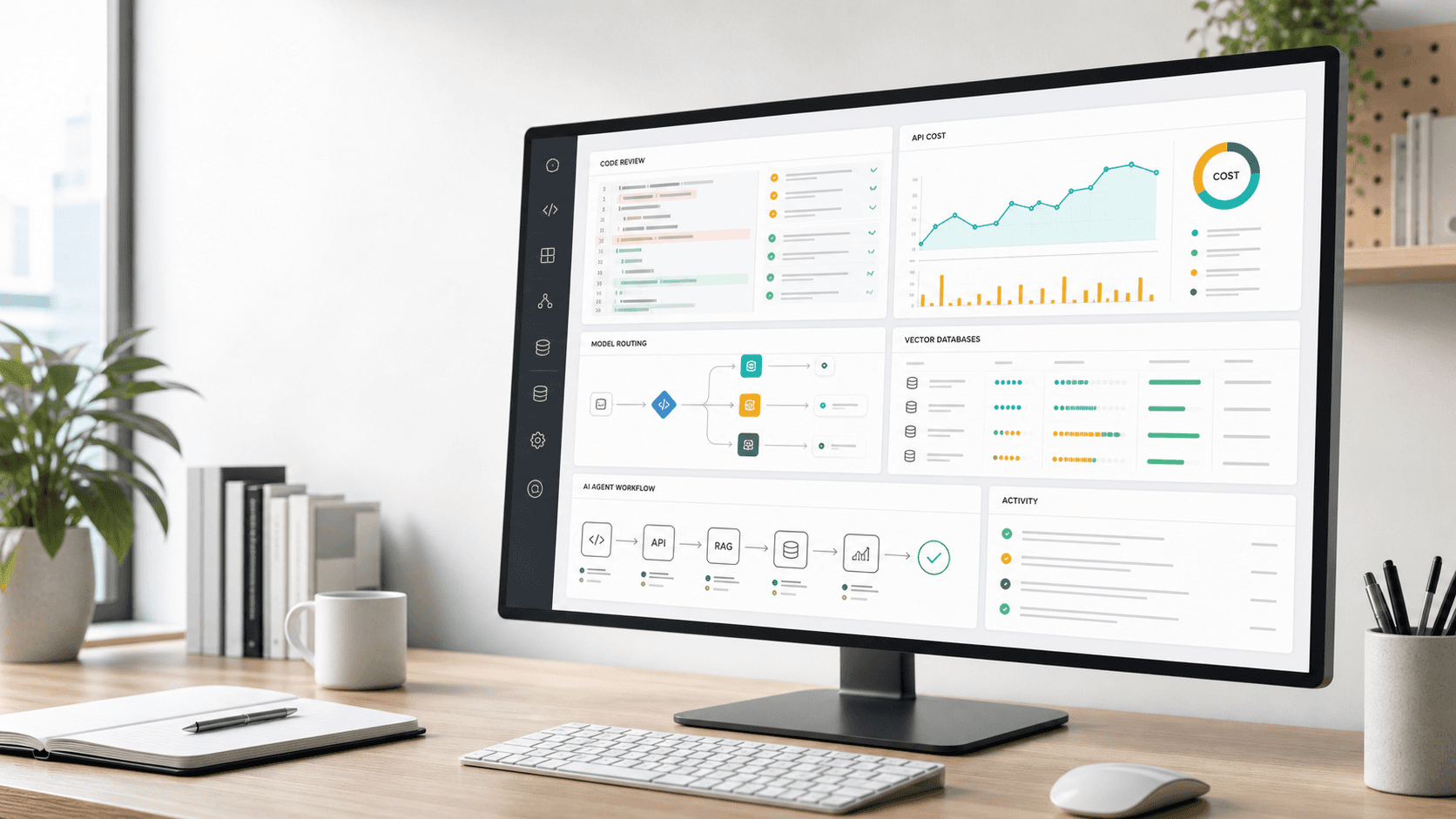
Independent English guides for AI coding tools, agent platforms, vector databases, API cost calculators, and developer SaaS alternatives.
Estimate token spend, retries, cache impact, and routing strategy before costs surprise you.
Compare orchestration, tools, memory, deployment controls, traces, and human approval.
Choose RAG infrastructure by hybrid search, filtering, freshness, latency, and operations.
Evaluate seats, usage limits, codebase context, enterprise controls, and accepted diffs.
Free planning tool
Estimate monthly model spend from requests, token usage, retries, cache hit rate, provider pricing, and human review time. Use it to compare feature-level workloads before a prompt, model, or agent workflow reaches production volume.
Tokens
Input and output volume by feature
Retries
Validation failures and repair overhead
Routing
Model mix, cache savings, and review time
Featured guides
Each guide targets a practical decision developers and founders search for before spending money: pricing, alternatives, infrastructure, security, and workflow fit.
Developer Tools
Compare AI coding assistants by cost structure, seat controls, privacy posture, and developer workflow fit.
Developer Tools
A developer-focused framework for choosing AI agent platforms by orchestration, tools, memory, security, and production observability.
Developer Tools
Compare LLMOps platforms by prompt management, evaluations, observability, deployment, governance, and cost control.
AI Coding Tools
A practical comparison of AI coding assistants for individual developers, startups, and engineering teams.
AI Coding Tools
Compare Copilot Business and Enterprise by codebase context, policy controls, security features, and rollout cost.
AI Agent Platforms
Compare popular AI agent and RAG frameworks by orchestration, retrieval, multi-agent design, production fit, and developer experience.
RAG & Vector Databases
Compare Pinecone, Weaviate, and Qdrant for RAG applications by hosting model, filtering, hybrid search, cost, and operations.
RAG & Vector Databases
Compare vector databases and search backends by retrieval quality, hybrid search, filtering, latency, scale, and operational cost.
API Cost Calculators
Estimate LLM API cost with input tokens, output tokens, cache strategy, retries, batching, and model routing.
API Cost Calculators
Compare LLM API pricing across providers using token shape, model routing, latency, quality, caching, and operational risk.
SaaS Alternatives
Compare SaaS developer tools and alternatives by switching cost, integrations, pricing model, data export, and team workflow.
SaaS Alternatives
Compare Vercel alternatives for Next.js by hosting model, edge features, build limits, pricing, observability, and lock-in.
Publication standards
AI Jupyter is implemented as a real publication: original articles, visible navigation, policy pages, a sitemap, a robots file, and no misleading ad prompts.
Original English editorial content for developer buying decisions
Clear navigation, author identity, contact page, privacy policy, terms, and advertising disclosure
No scraped articles, no auto-generated doorway pages, and no deceptive ad labels
Commercial relationships are disclosed and never presented as navigation
Topic map
The site focuses on topics where English-speaking searchers often compare tools before subscribing, integrating, or migrating.
Compare AI coding assistants by cost structure, seat controls, privacy posture, and developer workflow fit.
A practical startup stack for AI coding, model APIs, vector search, observability, evals, deployment, and cost control.
A developer-focused framework for choosing AI agent platforms by orchestration, tools, memory, security, and production observability.
Evaluate LLM monitoring tools for traces, prompt versions, token cost, quality metrics, privacy, and incident response.
Compare LLMOps platforms by prompt management, evaluations, observability, deployment, governance, and cost control.
Evaluate AI code review tools by bug detection, false positives, security coverage, pull request workflow, and reviewer trust.
Practical frameworks, scorecards, and decision rules rather than copied vendor copy.
Server-rendered pages, canonical metadata, sitemap, robots, and descriptive internal links.
Ads are clearly labeled only when configured, and content remains the primary page value.